
Four roles of a Manager
As a Manager, you step into multiple roles every day each shaping how you lead, enable, and influence your team.
Read on to explore the four key roles of a Manager, and take a few minutes to answer the questions at the end.

The Manager, the Director
- Directs the Team member
- Towards goals, with a strategy for achievement
- On “how to” of the task: steps, actions, instructions
- To meet their professional objectives and personal growth plans
- To follow discipline, process and policies
- Direction is about correcting, informing and instruction.
- The manager uses all their experience and know-how to be able to guide the team members towards the successful achievement of goal.
In this role, the Manager proactively monitors milestones and timelines; takes preventive and corrective steps to ensure results are achieved.

The Manager, A Negotiator!
As a Negotiator, the Manager:
- Negotiates with stakeholders: To arrive at clarity, alignment, and mutual commitment towards a COMMON GOAL
- Focuses on “needs” rather than positions: Its not an Ego ride of ME vs YOU/THEM. Its about what WE WANT.
- Aligns Needs with the Larger Business objective: The needs being negotiated for must meet the overall Business goal. Personal and team needs must serve the goal of the business.
- Anchors every discussion in MUTUAL GAIN: Negotiation is not about winning—it is about creating outcomes where all parties move forward together
- Sees the COMPLETE picture: Considers impact on people, process, timelines, and outcomes. Moves beyond short-term fixes to long-term alignment.
- Negotiation is about the SITUATION, not the PERSON. The Manager separates the issue from the individual, ensuring respect and psychological safety.
This role is about balancing interests, expectations, and constraints to enable progress without damaging relationships.

The Manager, the Facilitator
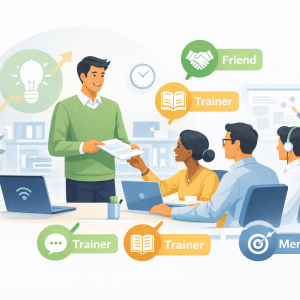
In this role, the Manager removes barriers, builds capability, and creates conditions for individuals and teams to perform at their best
- Facilitates smooth and effective working: By enabling people to focus on outcomes rather than obstacles
- Acts as the provider and ensures undisrupted availability of essential resources: Right tools, systems, information, and access
- Creates comfort and convenience to enable productivity: Reduces unnecessary friction in ways of working. Builds an environment where people can do their best work.
- Supports capability building and growth: Enables access to learning, exposure, and skill upgrades. Encourages continuous development of competencies
- Plays multiple facilitating and enabling roles when required
• As a friend – building trust and approachability
• As a trainer – sharing knowledge and best practices
• As a mentor – offering guidance from experience
The Manager, the Coach
The Manager functions as a Coach by:
- Listening more and talking less: Creating space for thinking not providing answers
- Asking, not leading: Using powerful questions instead of direction or advice
- Exploring with curiosity / genuine interest: Staying open, non-assumptive, present
- Believing answers lie within the individual: Suspending judgement, trusting the person’s capability
- Challenging comfort and “easy” responses: Encouraging deeper thinking & accountability
- Working with strengths rather than weaknesses: Building confidence and sustainable growth
- Facilitating action planning and ownership: Supporting clarity, commitment, and self-driven action
Coaching is about unlocking potential, not giving solutions.

Difference between them…
How Coaching is Different from Other Managerial Roles
- Director – Tells what and how
- Negotiator – Aligns interests and expectations
- Facilitator – Arranges resources and removes obstacles
- Coach – Enables thinking and self-discovery
The Key Shift to Being Coach-like?
From driving answers to evoking insight and ownership