
Your scores are:
| Styles | Your Scores |
|---|---|
| Driver | Row 1, Content 1 |
| Expressive | Row 2, Content 2 |
| Amiable | Row 3, Content 1 |
| Analytical | Row 3, Content 1 |
Social Styles in Action: Understanding the Value of How You Show Up
You’ve just completed a quick but revealing self-assessment based on the social styles model developed by psychologists Merrill and Reid. Their research uncovered four primary styles people tend to lean on when interacting: Analytical, Driver, Amiable, and Expressive.
This isn’t about boxing people in, everyone has access to all four. But your scores highlight your natural tendencies, the lenses through which you make decisions, lead conversations, and respond under pressure.
Why It Matters in Business:
High-performing teams don’t just have diverse resumes—they have diverse styles. And when each style is understood and used well, collaboration feels smoother, meetings are more productive, and deals move forward faster.
Let’s take a look at what each style looks like in action:
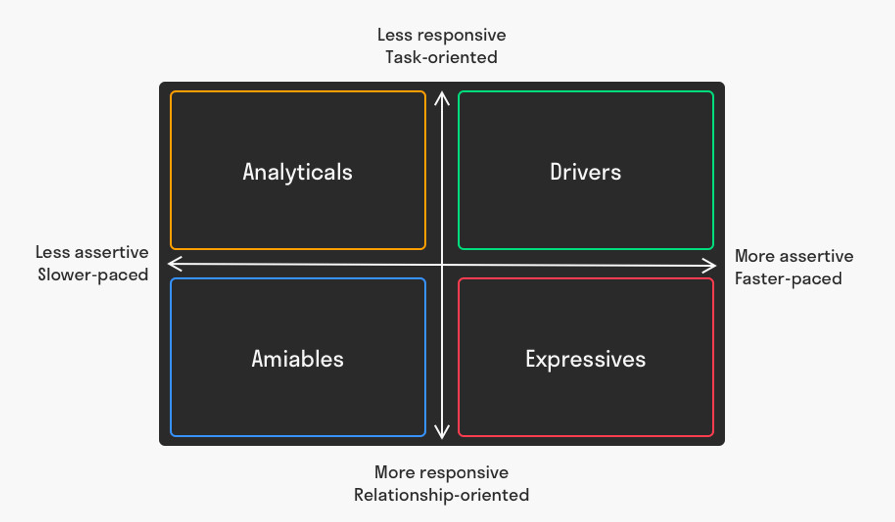
The top-left quadrant represents the group of analytical people from the Merrill social styles model. This group of people is thoughtful and cautious. They generally want to make sure they have all the information they need before getting into something. Their favourite approach to problems and issues is risk minimisation by considering all possible options. Others tend to view this group as cool, cautious, serious, precise, objective, rational, and sometimes distant.
Mindset: “Let’s get this right.”
Strengths: Detail-focused, thoughtful, methodical.
You might score high here if…
You prep for a sales call by studying reports, company history, or LinkedIn breadcrumbs.
You’re the person who spots the inconsistency in a proposal, or double-checks the numbers.
You prefer saying, “Let’s think this through,” rather than jumping to solutions.
Analytical people love facts. They work accurately, orderly, and methodically, and follow standard procedures, rules, and best practices in their activities.

Other characteristics of this group include:
- Focus more on tasks than on people
- Like to be right and take the time to show this
- Are reflective, cautious, and precise
- Are good at evaluating and solving problems
- Are good at working alone, avoid group activities
- Are careful when making decisions
- Are critical and have low responsiveness
The right-bottom quadrant represents the group of expressive people from the Merrill social styles model. These people are adventurous and move fast in life. Expressives like to share new ideas and plans. Their favourite approach to a problem or issue is to create a vision for the future and seek support from others by emphasising the advantages.
Mindset: “Let’s get excited.”
Strengths: Visionary, energetic, great storytellers.
You might score high here if…
You break the ice with humor or a success story on a first call.
You tend to say “This could be huge!” or “Imagine if we…”
You thrive in brainstorming rooms where big ideas are welcome.
They are experts at making others feel energetic, working enthusiastically, using humour in work, and taking risks. Others view this group of people as impulsive, creative, and convincing.

Other characteristics of the group of expressives include:
- Intuitive
- Creative
- Enthusiastic
- Spontaneous
- Funny
- Easily interact with others
- Are afraid of being rejected
- Love confirmation and praise
- Don’t like routine and complex matters
- Tend to generalise and exaggerate
- Use a sarcastic tone when they’re stressed
The top-bottom quadrant represents the group of amiable people from the Merrill social styles model. These people are thoughtful, kind, support others, and take their time to build a good relationship with others. They prefer to approach a problem or issue by reaching consensus. They often play a mediating role in such situations.
Mindset: “Let’s stay connected.”
Strengths: Empathetic, collaborative, steady.
You might score high here if…
You remember birthdays, check in after someone’s tough week, or diffuse tension in meetings.
You’re the person others turn to for a read on “how the team is feeling.”
You focus on harmony and tend to say, “Let’s make sure everyone’s onboard.”
Amiables believe that the best solution is a solution that brings all stakeholders on board. Others view this group as kind, friendly, and self-deprecating.

Other characteristics of this group include:
- Listen attentively
- Excel at teamwork
- Want to be respected
- Want to be popular
- Want to be seen as nice
- Look for safety and stability
- Like organised workplaces
- Take their time to make decisions
- Prefer following orders to taking the lead
- Are afraid of change and uncertainty
The top-right quadrant represents the group of drivers from the Merrill social styles model. These individuals are highly assertive and have low responsiveness. The people in this category make decisions quickly, are impatient, and get angry when others can’t keep up. Their favourite approach is to act quickly based on the available and relevant information, and to course-correct later if necessary.
Mindset: “Let’s get it done.”
Strengths: Decisive, focused, efficient.
You might score high here if…
You love setting aggressive targets and hitting them.
You step in when a meeting drifts, saying “Let’s land this” or “What’s the next step?”
You’re energized by tight timelines and bold goals.
These people are specialised in pragmatism, staying cool under pressure, and completing tasks quickly. Others view this group as task-oriented, efficient, and demanding.

Other characteristics of this group include:
- Are competitive and want to want
- Always look for control and to take over control
- Are quick in their actions and reactions
- Are good at planning
- Being decisive
- Are result-oriented
- Are task-oriented
- Don’t like inefficiency and weak decisiveness